S. Gallardo lecture notes
Lecture outline:
Boys, Girls, & Brains
- Boys are up to four times more likely to have autism, ADD, and dyslexia
- Girls are twice as likely as boys to suffer depression, anxiety, and eating disorders
- Boys 73% more likely to die in accidents, twice as likely to be victims of violent crimes (AfrAm males 6x?).
- Girls are twice as likely to attempt suicide, but boys are three times likelier to succeed at it.
- Girls of all ages get better grades than boys, yet…
- boys continue to score 25 points higher on SAT,
- males outnumber females 4:1 in college engineering degrees.
I. Sex Differences in the Brain:
1, 2, 3
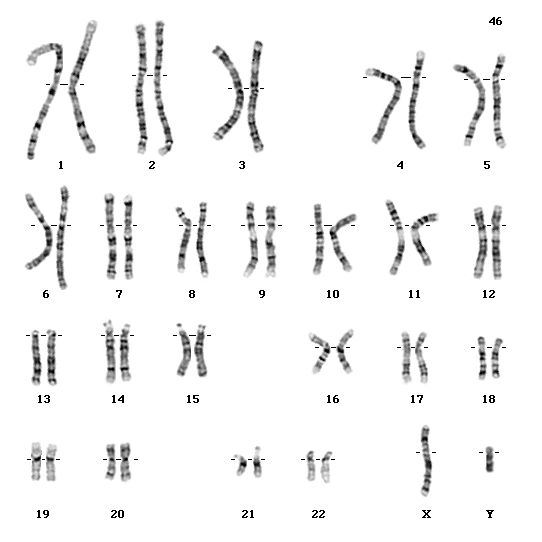
Males and females share roughly 99.8% of their genes
II. The nature of the brain:
- Plasticity - the brain changes in response to experience, reinforces active brain circuits at the expense of other inactive ones.
- Your brain is what you do with it
- "The older boys and girls are, the less confidently we can determine that their differences are the result of genes and hormones."
- “they germinate from basic instincts and initial biases in brain function, but each of these traits is massively amplified by the different sorts of practice, role models, and reinforcement that boys and girls are exposed to from birth onward.” (7)
- Epigenetic - the environment acting on or through our genes
III. The misuse of neuroscience -
- The delicacy of scientific standards - what makes a good study?
- "It's sexy to find difference" - file drawer effect

- Misrepresentation by media
IIIx. The Difference value
0.2 Small difference
0.5 Medium difference
0.8 Large difference
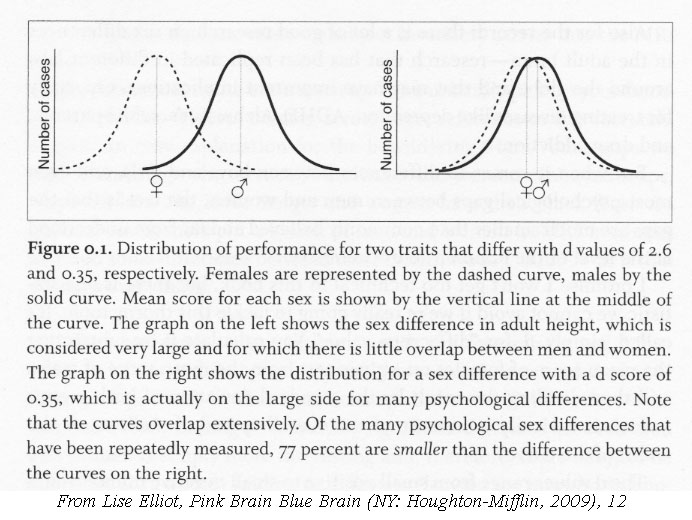
"The Gender Similarities Hypothesis" --Dr. Janet Hyde, U Wisconsin
Lueptow Study - U of Akron, Ohio
Summing up
What factors affect our perception of male and female differences?
- Human penchant for extremes, stereotypes
- Media misrepresentation
- Media overrepresentation
- Capitalist profitseeking - gendering products
On to the womb
What makes a boy?
- Y chromosome, and the SRY
- Testosterone, and the Anti-Mullerian Hormone
- More testosterone, peeking at 14-16 weeks (AIS)
What makes a girl? 
- DAX1 gene on X chromosome
- Estrogen, not active til after birth

Intersexual stories
- David Reimer, changed at 18 mos
- 1998 case, changed at 7 mos.
- CAH Congenital adrenal hyperplasia
Sex Detectives:
- finger-length ratios
- not prenatal movement, heartrate, etc.
On the fragility of boys
- conception ratio 170:100
- maturity