S. Gallardo lecture notes
Lecture outline:
Computer Science and Unlocking the Clubhouse
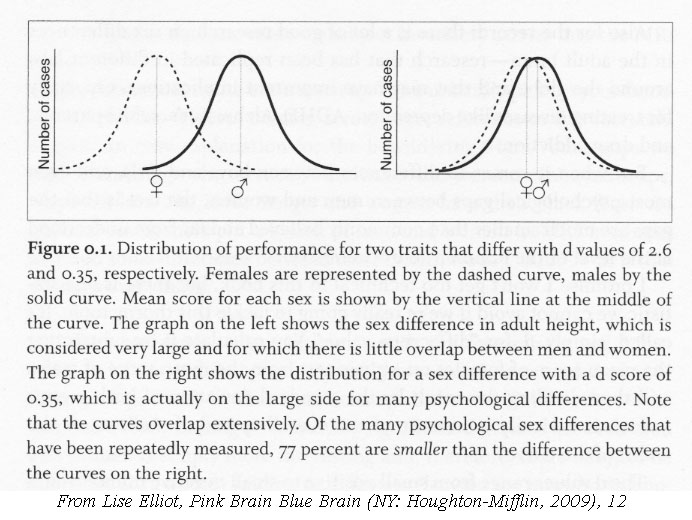
If we are generally equal in cognitive abilities, how do we account for the gender gap?
What factors influence how we think, do at science and math?
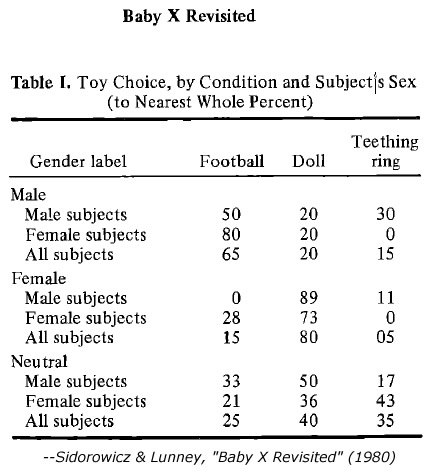
Baby socialization...
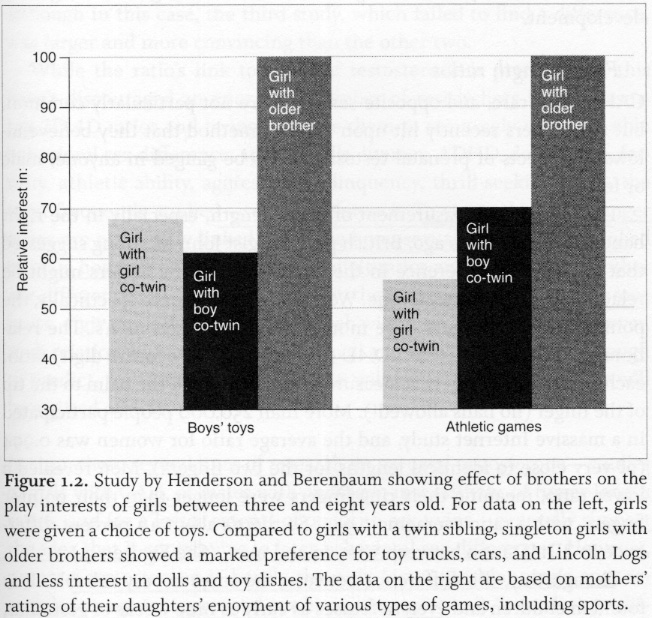
Family/sibling context
Social anxiety, conditioning

How did students get interested in computing ?
- Early childhood socialization –
- toys - Rheingold & Cook (1975), Nash & Fraleigh (1993), F. Hughes (2003)
- roaming radius, 2452 vs. 959
- Student work on toys
- Parents - Over and over, parents describe their effort to treat their children equally, to support them in their interests. And yet...
- Role Model
- Mentors
- School –
- High school - peers & pedagogy
- College - Why they chose it, why they stay, the attraction of programming
Nature/Nurture Theories - Essential vs. social construction; innate vs. learned….or both? How do they interact?
Unlocking the Clubhouse
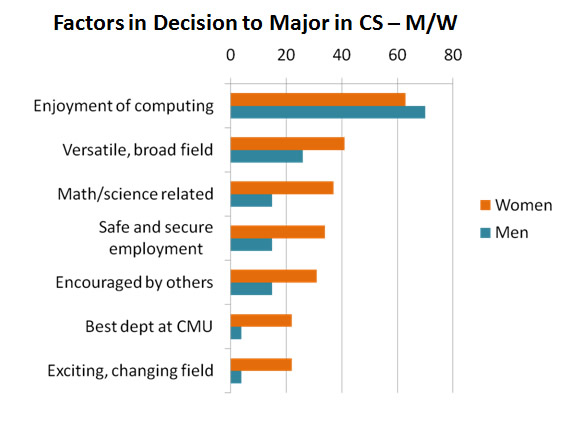
- Interest factors and gender at Carnegie Mellon University

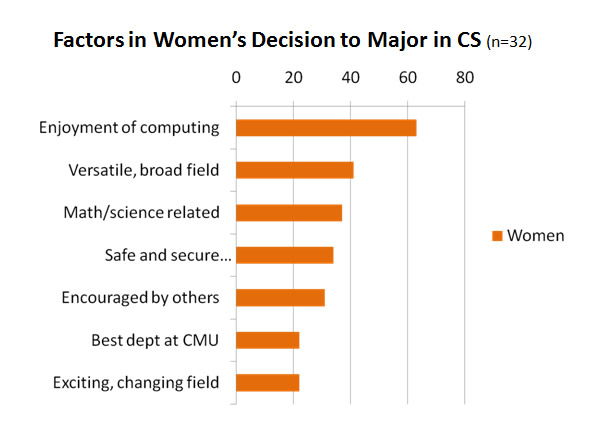
Compare both:
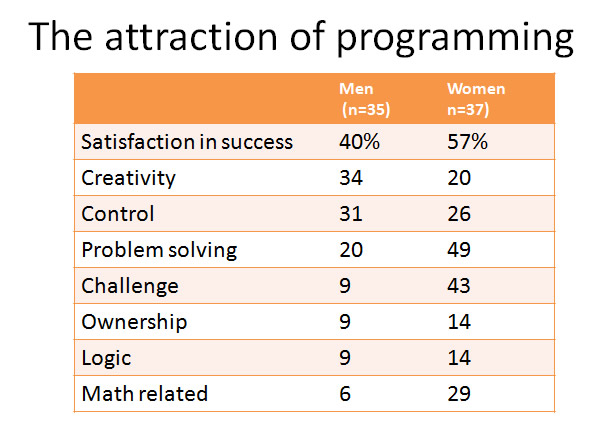
Does it have to be this way?
Malaysian gender dynamics in computing
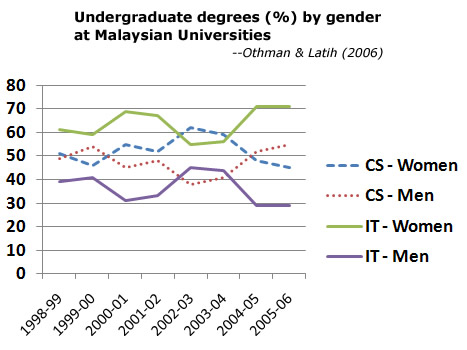

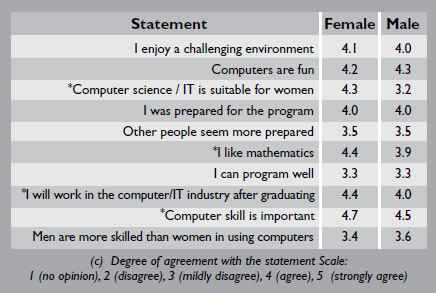
Malaysian Attitudes at entry into CS program
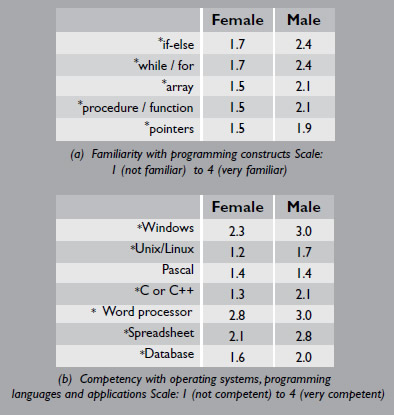
And confidence in competency...
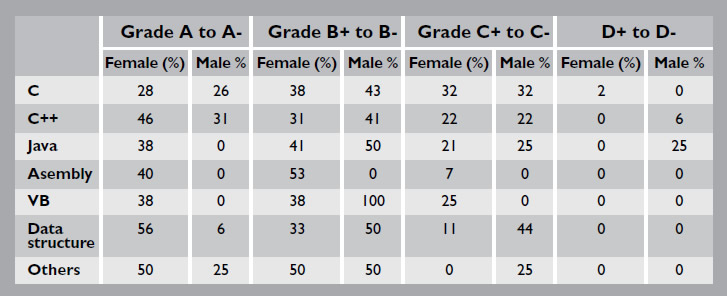
And Malaysian grades...
How is CMU the same as Malaysian universities?
How is it different?
Why?
Stanford biologist Paul Ehrlich (2000)
"The relative contributions of heredity and environment to various human attributes are difficult to specify. They clearly vary from attribute to attribute. So, although it is informative to state that human nature is the product of genes’ interaction with environments (both internal and external), we usually can say little with precision about the processes that lead to interesting behaviors in adult human beings. We can’t partition the responsibility for aggression, altruism, or charisma between DNA and upbringing…." (28)
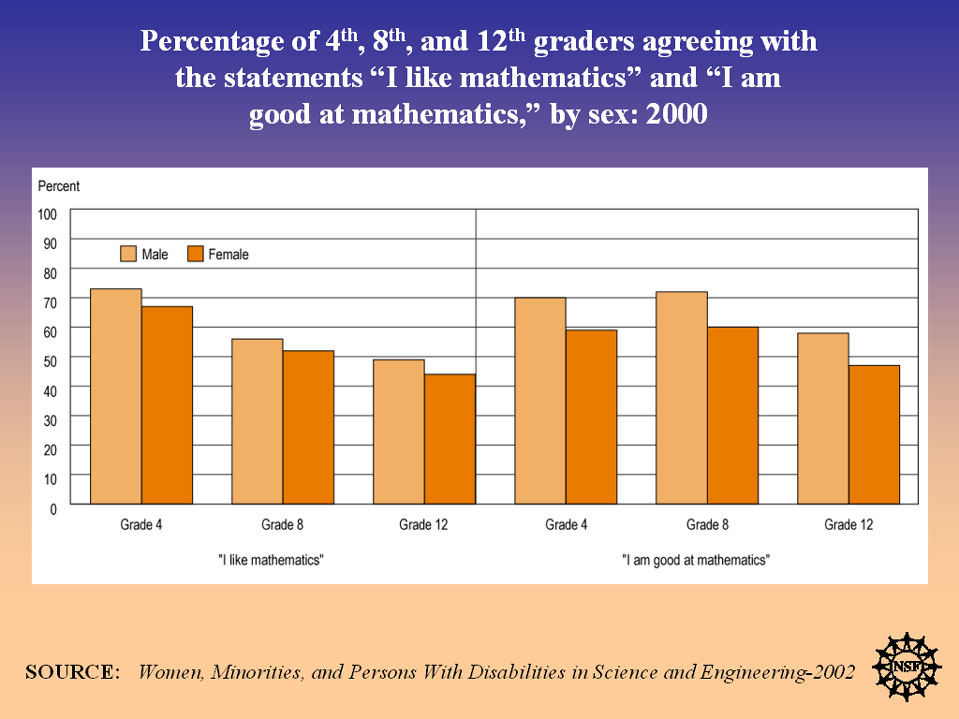
Starting in grade school (chart)
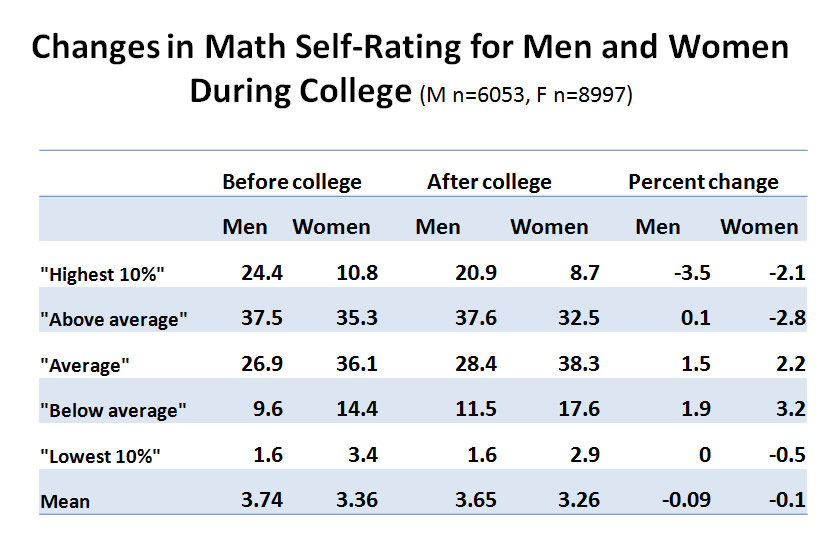 --L.Sax, HERI, 1994
- Men’s self-ratings tend toward “above average”, while women’s closer to “average”
- One in four men rated selves in highest ten percent; only one in ten women did.
- Greater percentage of women designate themselves in bottom two categories
- Mean declines are similar for men and women
- Proportional loss of students rating selves “above average” or “highest 10” is greater among women. Thus:
- Our most confident students in math are becoming less mathematically confident during college
- The effect is stronger for women
- Magnitude of the decline is greater in more selective schools
Multiple layers of gender socialization
- Teachers’ unquestioned assumptions about male tech superiority, grounded in U.S. culture
- Teachers’ own male gender socialization, interaction with students (perpetuating male privilege, jokes…)
- Pedagogy – teachers often perpetuating male-oriented technology (examples, adhoc comments, rationale)
- Girls/women actual competence
- Girls’ women confidence in ability
- Girls’ desire to fit (or not) social norms about competence with computers (and downplay ability?)
- Parents ?
- Peers ?
What factor/s distinguished those women who persisted at CMU? Why?
Seymour & Hewitt (1997):
"Perhaps the most important single generalization arising from our analysis is that we did not find switchers and non-switchers to be two different kinds of people...we did not find them to differ by individual attributes of performance, attitude, or behavior to any degree sufficient to explain why one group left, and the other group stayed."
Attributional Beliefs about Intelligence and Talent (99)
- "Computer Gene Theory" - Fixed intelligence, "you are born with the talents you have, and nothing you can do can change them"
- Hard work theory - "lagan" (Hindi), ganas (Span) - putting your nose to the grindstone
"Believing in the link between effort, hard work, and success seems to be the mantra...."
Women who persist (103)
- those who find a way to get grades they are satisfied with and who can develop a personalized view of computing and their place in it.
- Women who accept the prevailing culture as the norm and who continuously compare themselves to this norm and find themselves coming up short [inevitably] are the ones who suffer the most.
- Authors suggest that international women had lower expectations about "fitting in", actually acclimated better.
How to persist:
- Surround yourself with supportive people (family, friends, relationships, social orgs
- Supportive learning communities - Treisman study, 1992- integrating studying and learning into
social lives, not academically isolated
- Stick it out through second year
- Reconcile your relationship to the prevailing culture
- Get grades you are satisfied with
- Understand patterns of learning (class 211) - get over the hump, when
"a sense of mystery about computing turns into a sense of mastery" (107)
Why girls do/not enroll - p. 113
Recruiting girls
- Deliberately focus on recruiting girls (not just neutral)
- Recruit friendship circles, "recruit a posse"
- Have girls recruit girls
- Recruit a "mover & shaker"
- Explain to counselors, teachers, and parents what compsci is, and why important
- Get girls interested early, at least middle-school
- Create girl-focused events, clubs, and camp to spark girls' interest
- Help teachers spread the word
- Expect opposition, teach teachers (explain how/why boys have already been recruited into compsci)
- Reshape the teaching of computer science - better teaching helps everybody
- Protect the classroom climate - not a boys' lockerroom